
How to Buy SFP and QSFP Transceivers for Data Centers in the UAE and Egypt

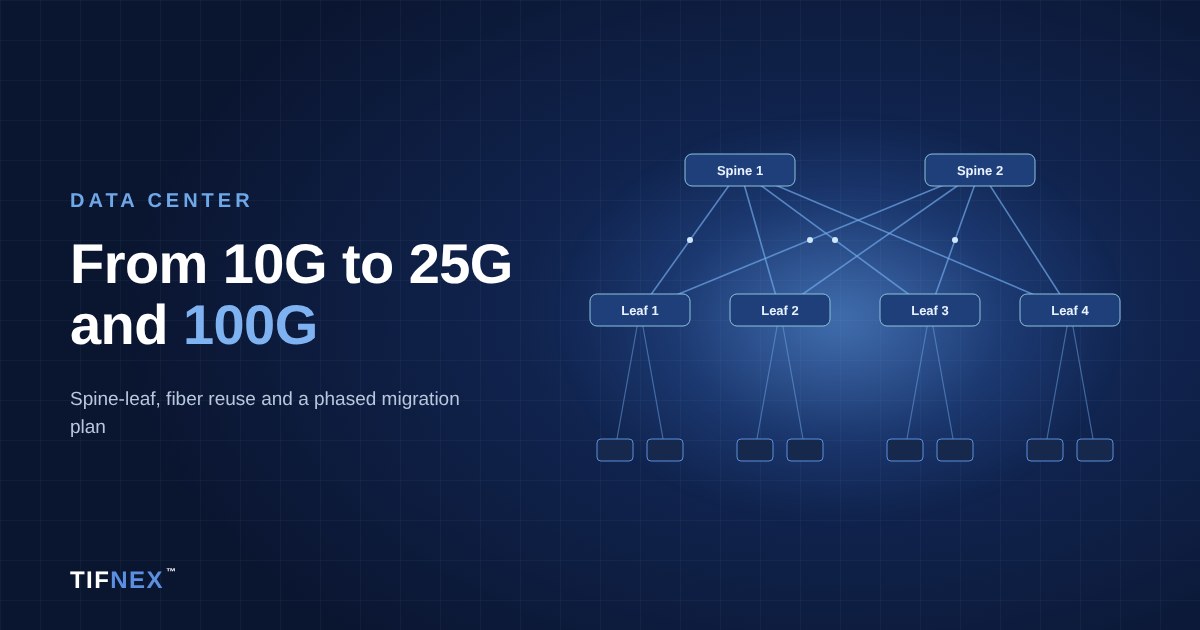
Buying optical transceivers for a data center looks simple until a module does not link up, a switch rejects it, or a delivery slips by three weeks. This guide is a practical checklist for data center, telecom and IT teams in the UAE and Egypt who need to buy SFP and QSFP transceivers: what to specify, what to ask a supplier, and how to avoid the common mistakes.
1. Start from the switch port, not the optic
The port on your switch or network card decides the form factor. Check the datasheet before anything else:
- SFP / SFP+: 1G and 10G ports, common for access, management and older server links.
- SFP28: 25G ports, the usual server-to-leaf speed in current racks.
- QSFP+ / QSFP28: 40G and 100G ports, used for leaf-spine uplinks.
- QSFP-DD / OSFP: 400G and 800G ports, used in AI and large cloud fabrics.
For the differences in detail, see SFP vs SFP+ vs SFP28 and QSFP transceivers explained.
2. Match reach and fiber type
The optic standard has to match the distance and the fiber already in the building. Short-reach (SR) optics run over multimode fiber (OM3, OM4, OM5) inside a hall. DR, FR and LR optics run over single-mode fiber (OS2) between rows, rooms or buildings. Mixing them up is the most common reason a new link stays dark. Our guide to single-mode vs multimode fiber covers the reach of each type.
3. Check the connector
Duplex LC is standard for most SFP, SFP28 and many QSFP28 optics. Parallel optics such as 100G-SR4, 400G-SR8 and 400G-DR4 use MPO/MTP connectors and need the right trunks and polarity. See the MTP/MPO polarity guide before you order cabling.
4. Decide between OEM and compatible optics
OEM-branded optics come from the switch vendor. Compatible optics follow the same MSA standards and are coded to identify correctly in your switch, usually at a lower price. The deciding questions are how the supplier tests and codes modules, and what the warranty covers. Read compatible vs OEM transceivers for the full comparison.
5. Consider DAC and AOC for short links
Inside a rack or between neighbouring racks, a direct attach copper (DAC) or active optical cable (AOC) is often cheaper and uses less power than two optics plus a patch cord. See DAC vs AOC vs transceivers.
6. What to send a supplier for an accurate quote
- Switch or NIC model on each end of the link
- Speed and form factor (for example 100G QSFP28)
- Distance and fiber type (OM4, OS2)
- Connector type (LC or MPO)
- Quantity, including spares
- Delivery city (Dubai, Abu Dhabi, Cairo, Alexandria or elsewhere) and the date you need it
7. What to check in the quote
- The full part description: form factor, speed, standard, wavelength, reach and connector
- The platform each module is coded for
- Lead time and whether stock is held in the region
- Warranty length and how replacements are handled
- Whether the supplier can support you in Arabic and English on site and by phone
Buying in the UAE or Egypt
TIFNEX supplies SFP, SFP28, QSFP28, QSFP-DD and OSFP transceivers, DAC and AOC cables and fiber from its head office at Al Dana Center, Deira, Dubai and its branch in Zahraa Al Maadi, Cairo. Products are genuine with full warranty, compatibility-tested for your switch platform, and quoted within 24 hours.
- SFP and QSFP transceiver supplier in the UAE
- SFP and QSFP transceiver supplier in Egypt
- Browse all optical transceivers
Frequently asked questions
How do I know which transceiver my switch needs?
Check the port type on the switch datasheet (SFP, SFP28, QSFP28, QSFP-DD or OSFP), the speed, and the reach you need. Then match the optic standard, such as SR for short multimode links or LR for longer single-mode links. Sending the switch model to your supplier is the fastest way to confirm.
Are compatible transceivers safe to use in a data center?
Yes, when they follow the relevant MSA and are coded for your switch platform. Ask the supplier how modules are tested and what warranty covers them.
What should a transceiver quote include?
Exact part description (form factor, speed, standard, wavelength, reach, connector), the platform it is coded for, quantity, unit price, lead time, warranty and delivery terms.
Where can I buy SFP and QSFP transceivers in the UAE and Egypt?
TIFNEX supplies SFP, SFP28, QSFP28, QSFP-DD and OSFP transceivers from its head office in Deira, Dubai and its branch in Zahraa Al Maadi, Cairo.