DAC vs AOC vs Optical Transceivers: How to Choose for Each Link

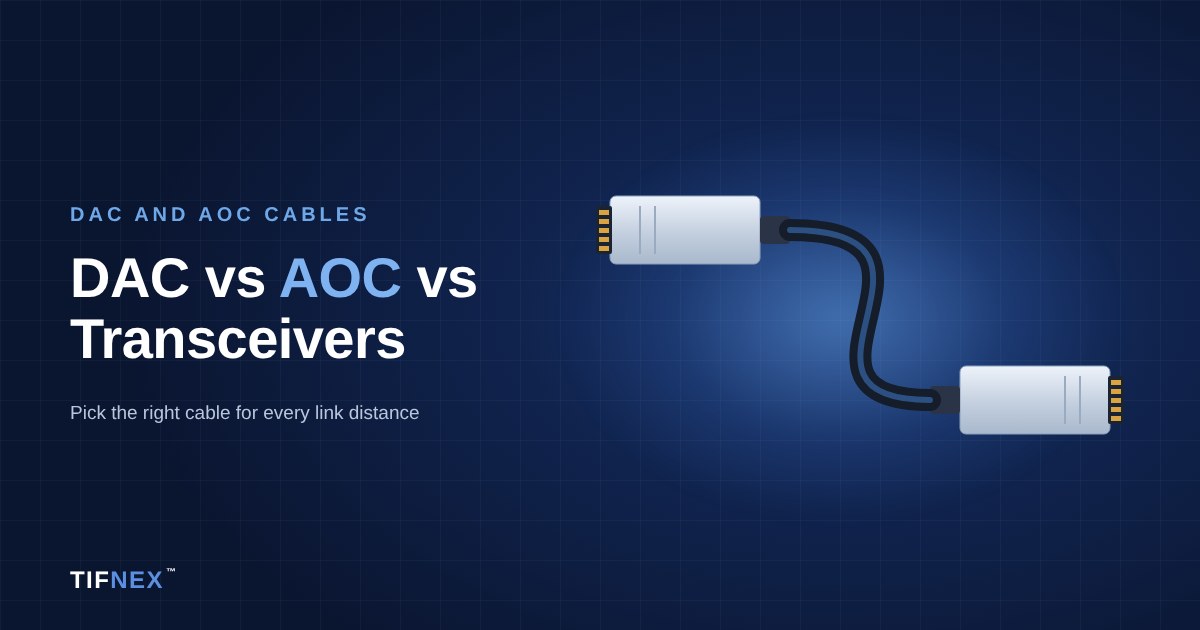
In the DAC vs AOC choice, distance decides most links: passive DAC is the cheapest, lowest-power option for runs of a few metres inside a rack, while AOC covers tens of metres with a thin, light fibre cable. Beyond that, or anywhere the link passes through patch panels, use optical transceivers with separate fibre.
There is a fourth option too: active copper, including active electrical cables (AEC), which stretch copper reach at 400G and 800G. This guide compares all four on reach, power, latency, cost and cable bulk, and maps them to top-of-rack, row and room-scale links.
The Four Options in Brief
Passive DAC (direct attach copper)
A passive DAC is twinax copper cable with a module shell on each end and no signal electronics in the path. The host’s SerDes drives the cable directly. That makes it nearly zero-power and very low latency, but reach drops sharply as lane speeds rise.
Active copper: ACC and AEC
Active copper cables add chips in the connector ends. An ACC (active copper cable) uses linear redrivers to boost the signal. An AEC (active electrical cable) uses retimers that fully recover and regenerate the signal, which gives the longest copper reach at 50G and 100G per lane. Both draw some power, though far less than a pair of optics.
AOC (active optical cable)
An AOC has optical transmitters and receivers built into each end, joined by a permanently attached fibre cable. To the switch it looks like a transceiver, but there are no exposed fibre connectors to clean or mismatch. It is sold in fixed lengths.
Transceiver plus fibre
Two pluggable optical transceivers joined by patch cords or a structured cabling plant. This is the most flexible option: any length, any route through panels, and the optic and fibre can be replaced separately.
Reach by Speed
Copper reach shrinks as per-lane speed rises, because twinax loss grows with frequency. Optical reach depends on the module type rather than the cable. The figures below are typical of the IEEE copper specifications and products sold today; exact limits vary by cable gauge and host.
| Speed (lane rate) | Passive DAC | Active copper / AEC | AOC | Transceiver + fibre |
|---|---|---|---|---|
| 10G SFP+ (10G NRZ) | Up to about 7 m | Up to about 10 to 15 m | Commonly up to 100 m | 300 m OM3 (SR) to 40 km+ (ER) |
| 25G SFP28 / 100G QSFP28 (25G NRZ) | Up to 5 m (RS-FEC) | Up to about 7 to 10 m | Commonly up to 100 m | 100 m OM4 (SR) to 10 km+ (LR) |
| 200G / 400G (50G PAM4) | Up to about 3 m | Up to about 5 to 7 m | Tens of metres, often up to 30 to 100 m | 100 m OM4 (SR8) to 10 km (LR4) and beyond |
| 800G (100G PAM4) | Up to about 2 m | Up to about 5 to 7 m | Tens of metres | 50 to 100 m multimode, 500 m to 10 km single-mode |
The practical reading: at 10G and 25G a passive DAC easily spans a rack and often the next one. At 400G and 800G it barely covers a single rack, which is exactly the gap AECs were designed to fill.
Power, Latency and Cost
Power
A passive DAC uses essentially no power. AECs and ACCs draw a few watts per end because of their chips. AOCs and transceivers draw the most, since each end has lasers, drivers and, at 50G and 100G lanes, a DSP. As a rough guide, a 100G SR4 module draws around 2 to 3.5 W, and many 400G optics draw 8 to 12 W each. Across a full leaf switch with dozens of server links, that difference shows up in both the power budget and the cooling load.
Latency
Passive DAC adds only propagation delay. Retimed AECs and DSP-based optics add a small amount of processing delay at each end. For most workloads the difference is negligible, but low-latency trading and some HPC designs prefer passive copper where the distance allows. Note that FEC, which adds its own delay, is set by the Ethernet speed rather than the medium: a 100G-per-lane link runs RS-FEC whether you use DAC or optics.
Cost
For the same speed and length, passive DAC is usually cheapest, followed by AEC, then AOC, then a pair of transceivers plus fibre. The order can change with volume and length, and transceivers often win on total cost when you factor in structured cabling you already own, reuse at the next refresh, or replacing a single failed optic rather than a whole cable.
Cable Bulk, Airflow and Handling
Copper gets thicker as it gets longer, because longer DACs need heavier gauge wire to keep loss in check. A bundle of 3 m 400G DACs is stiff and heavy, needs a generous bend radius and can block airflow at the rear of a densely cabled switch. In hot equipment rooms, which are common in the UAE and across the GCC, that blocked airflow matters.
AOCs use thin, flexible fibre that routes easily through cable managers and leaves room for air. AECs are thinner than an equivalent passive DAC at the same length, because the retimers allow lighter-gauge copper. Transceivers with fibre patch cords give the cleanest result in high-density rows, especially with MPO trunks feeding cassettes and panels.
Handling matters too. DACs and AOCs are fixed length, so you need to stock several lengths and manage slack. If one end of an AOC fails, the whole cable is replaced. With transceivers, you can swap the optic and keep the fibre in place.
Which Option for Each Link
Inside the rack (ToR to server)
This is the home of passive DAC. A top-of-rack switch connecting servers 0.5 to 3 m away is the ideal case: lowest cost, lowest power and no optics to manage. At 25G and 100G, passive DAC cables cover almost every in-rack run. At 400G and 800G, check the length carefully: once a run approaches 3 m, move to an AEC.
Adjacent racks and middle-of-row
For runs of 3 to 7 m at high speed, active copper and AEC keep the copper advantages of low power and simple handling. Beyond that, or when the cable has to travel through overhead trays, AOC is lighter and easier to route. AI GPU racks often use AECs or AOCs between servers and leaf switches for this reason.
End-of-row, room and building
Once a link spans a row, crosses a room or goes through patch panels, use transceivers and structured fibre. Leaf-to-spine links, links to a meet-me room and anything between buildings fall here. Pick the reach class (SR, DR, FR, LR) to suit the distance and fibre type, and use patch cords or MPO trunks that match the module’s connector.
Breakout links
All four options come in breakout form, such as one 400G port to four 100G servers. Breakout DACs suit in-rack fan-out, while breakout AOCs and optics with fanout fibre suit longer runs. See our breakout cables guide for lane mapping and port configuration.
How to Choose: A Quick Checklist
- Confirm the port and speed at both ends, including lane rate (for example 400G as 8 x 50G or 4 x 100G).
- Measure the real cable path, not the straight-line distance, and add slack for routing.
- Up to about 3 m (or 5 m at 25G): passive DAC.
- About 3 to 7 m at 400G/800G: AEC or active copper.
- About 7 to 30 m, point to point with no patch panels: AOC.
- Longer runs, or any link through patch panels: transceivers and fibre.
- Check power and airflow on high-density switches before committing to optics on every port.
- Get every cable and module coded for the specific switch and NIC at each end.
For larger builds, mixing the options is normal: DAC in the rack, AEC or AOC across a few racks, and optics to the spine. Our cloud data center team can help lay out the mix for a full row. For the transceiver side of the choice, see how to choose a 400G transceiver.
Frequently Asked Questions
What is the difference between DAC and AOC?
A DAC uses copper twinax cable and, in its passive form, has no electronics, so it is cheap and uses almost no power but only reaches a few metres. An AOC has optical transceivers built into each end and a fixed fibre cable, reaching tens of metres with a thinner, lighter cable.
How long can a 400G DAC be?
A passive 400G DAC using 50G PAM4 lanes typically reaches up to about 3 m. For longer copper runs, an active electrical cable (AEC) extends reach to around 5 to 7 m.
Is AOC better than a transceiver and fibre?
AOC is simpler and often cheaper for fixed point-to-point runs of tens of metres, with no connectors to clean. Transceivers with fibre are better for long runs, links through patch panels, and cases where you want to replace an optic without pulling the cable.
What is an AEC cable?
An AEC, or active electrical cable, is a copper cable with retimer chips in each connector that regenerate the signal. It extends copper reach at 400G and 800G to several metres while using less power than optical modules.
Does DAC have lower latency than optical modules?
Yes, a passive DAC adds only cable propagation delay, while optics and AECs add a small amount of processing delay at each end. For most applications the difference is negligible, and FEC delay applies equally because it depends on the link speed, not the cable type.
Talk to TIFNEX
Tell us your switch and NIC models, the cable paths you need to cover and the quantities, and our engineers will recommend the right mix of DAC, AEC, AOC and optics for each link, all coded for your platforms and tested before shipping. We quote within 24 hours and deliver across the UAE and the wider region. Contact TIFNEX or call +971 54 300 8970.