800G OSFP Transceivers for NVIDIA InfiniBand NDR: A Practical Guide

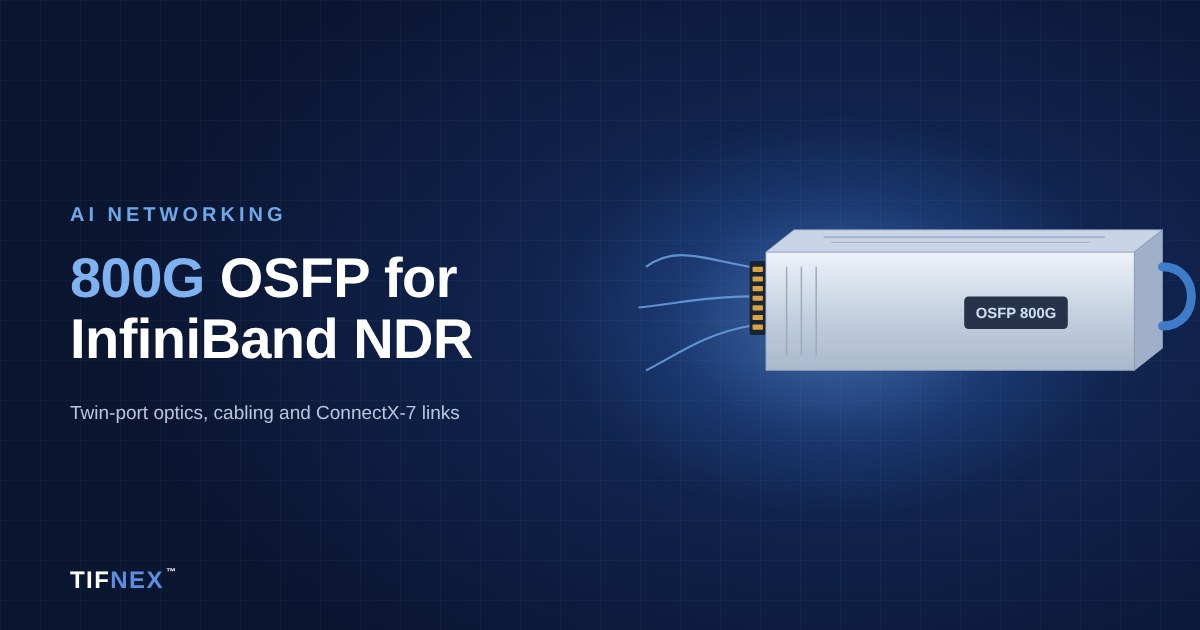
An 800G OSFP transceiver for NVIDIA InfiniBand NDR is a twin-port module: one OSFP cage on a Quantum-2 switch carries two independent 400 Gb/s NDR links. Each half connects to another switch port or to a ConnectX-7 adapter running at 400G, so choosing the right module means planning both ends of every link.
The common options are 2xSR4 on multimode fibre, 2xDR4 and 2xFR4 on single-mode fibre, plus copper cables for the shortest runs. This guide explains the module types, finned and flat-top versions, cabling, connectivity patterns and the thermal points that matter in a GPU cluster.
Twin-Port OSFP: How 800G Maps to NDR
InfiniBand NDR runs at 400 Gb/s per port using four lanes of 100G PAM4. A Quantum-2 switch exposes its ports through 32 OSFP cages, and each cage carries two NDR ports, for 64 ports of 400 Gb/s in one switch. The module in each cage is therefore an 8-lane, 800G-class OSFP that behaves as two separate 4-lane 400G ports.
That is why NVIDIA names these optics “twin-port” and uses labels such as 2xSR4 or 2xDR4. Each 400G half has its own optical connector and its own far end. Nothing in an NDR fabric runs as a single 800G InfiniBand link; the 800G figure is the total for the cage.
On the adapter side, ConnectX-7 runs NDR at 400 Gb/s. Depending on the card, the port is an OSFP cage or a QSFP112 cage, and it takes a single-port 400G module. Quantum-2 ports can also run at NDR200 (200 Gb/s) for some server designs, using splitter cables; check the cabling matrix for your exact parts before planning this.
Finned Top vs Flat Top OSFP
OSFP modules come in two mechanical styles, and they are not interchangeable in practice:
- Finned top: the module has its own integrated heat sink fins. Air-cooled Quantum-2 switches use finned-top twin-port modules, because the switch cages expect the module to carry its own heat sink.
- Flat top: the module has a smooth top surface and relies on a riding heat sink built into the host cage. ConnectX-7 adapters with OSFP cages use flat-top 400G modules, as do liquid-cooled switch designs.
A finned module will not fit a cage designed for a riding heat sink, and a flat-top module in a finned-top cage will overheat. Order by host type: finned twin-port for air-cooled switches, flat-top single-port for adapters.
NDR Transceiver Types: 2xSR4, 2xDR4 and 2xFR4
800G 2xSR4 (multimode)
Twin-port 2xSR4 uses 850 nm VCSELs over multimode fibre, with two MPO-12/APC connectors, one per 400G port. Each port uses 8 of the 12 fibres (4 transmit, 4 receive). Reach is up to 50 m on OM4 and 30 m on OM3. It is the lowest-cost optical option for links inside a row or between neighbouring racks.
800G 2xDR4 (single-mode, 500 m)
Twin-port 2xDR4 uses 1310 nm lasers over single-mode fibre, again with two MPO-12/APC connectors. Each port runs four parallel lanes of 100G and reaches up to 500 m. This is the standard choice for leaf-to-spine links across a data hall, and it pairs with a single-port 400G DR4 module on ConnectX-7 adapters.
800G 2xFR4 (single-mode, 2 km)
Twin-port 2xFR4 multiplexes four wavelengths onto one fibre pair per port and uses two duplex LC connectors. Reach is up to 2 km on single-mode fibre. It suits links between halls or buildings on a campus, and uses far fewer fibres than DR4 on long trunks, at a higher module cost.
What about DR8?
800G-DR8 is an Ethernet format: eight 100G lanes on single-mode fibre to 500 m, presented as one 800GbE port or broken out to lower speeds. It appears in Spectrum-4 based Ethernet fabrics, including Spectrum-X. In an InfiniBand NDR fabric, the twin-port 2xDR4 is the established equivalent. Some twin-port modules are listed for both InfiniBand and Ethernet use, so confirm the supported protocol for the specific part number.
NDR module comparison
| Module | Ports x speed | Fibre | Connectors | Max reach | Typical use |
|---|---|---|---|---|---|
| 800G 2xSR4 OSFP | 2 x 400G | Multimode OM3/OM4 | 2 x MPO-12/APC | 30 m OM3, 50 m OM4 | In-row switch-to-server, short leaf-spine |
| 800G 2xDR4 OSFP | 2 x 400G | Single-mode OS2 | 2 x MPO-12/APC | 500 m | Leaf-spine across a data hall |
| 800G 2xFR4 OSFP | 2 x 400G | Single-mode OS2 | 2 x LC duplex | 2 km | Inter-hall, campus links |
| 400G SR4 / DR4 (adapter) | 1 x 400G | MMF / SMF | 1 x MPO-12/APC | 50 m OM4 / 500 m | ConnectX-7 server ports |
| Passive DAC / ACC | 2 x 400G or split | Copper | Fixed cable | A few metres | Inside a rack |
Connectivity Patterns
Switch to switch
Between two Quantum-2 switches, use the same twin-port module type at both ends: 2xSR4 to 2xSR4, 2xDR4 to 2xDR4 or 2xFR4 to 2xFR4. Each module carries two cables, so one cage pair gives two NDR links. The two halves do not need to go to the same switch; a leaf can send one half to spine A and the other half to spine B.
Switch to ConnectX-7
The common server pattern splits one switch cage across two servers or two adapters. A twin-port 2xSR4 on the switch connects with two MPO-12/APC cables to two ConnectX-7 ports, each fitted with a flat-top 400G SR4 module (OSFP or QSFP112, depending on the card). The same pattern works with 2xDR4 on the switch and 400G DR4 modules on the adapters for longer runs. Match multimode to multimode and single-mode to single-mode; SR4 and DR4 do not interoperate.
MPO-12/APC cabling
SR4 and DR4 NDR optics use angled (APC, green) MPO-12 connectors. Using UPC MPO cables, or mixing APC and UPC, causes high loss and reflection. The cable must be 8-fibre-compatible, use the polarity the optic supplier specifies, and use OM4 for SR4 or OS2 for DR4. Inspect and clean every MPO end face before mating: at 100G per lane, one dirty fibre takes the whole 400G port down or drives up error counts. See our MTP/MPO trunks and jumpers, and the MTP/MPO polarity guide for polarity basics.
DAC, ACC and AOC Alternatives
For links inside one rack, copper is cheaper and uses almost no power. Passive DAC cables for NDR run from a twin-port OSFP to the same at the other end, or split to two 400G ends or four 200G ends for servers. At 100G per lane, passive copper reach is only a few metres, so it suits switch-to-server links in the same rack.
Active copper cables (ACC) add signal conditioning in the connector to extend copper reach a little further, still within a rack or to the next rack. Active optical cables are another option where supported, but most NDR builds use transceivers and structured fibre once links leave the rack, because a fixed-length AOC is harder to re-route or reuse. Browse DAC cables and active copper cables.
Power and Thermals
A twin-port 800G OSFP draws considerably more power than a 400G module, and a fully populated Quantum-2 switch holds 32 of them. Multiply that by hundreds of switches and adapters and optics become a visible part of the rack power and cooling budget.
- Check the switch airflow direction (power-to-connector or connector-to-power) and match it to the hot and cold aisles.
- Keep blanking panels in place and avoid cable bundles that block switch intakes or exhausts.
- Watch module temperature through DOM during burn-in; modules running close to their warning threshold point to an airflow problem.
- Prefer copper inside the rack where reach allows, since it saves optics power.
Looking Ahead: XDR and 1.6T
The next InfiniBand generation, XDR, doubles the per-port rate to 800 Gb/s using 200G-per-lane signalling. Switch cages move to 1.6T twin-port OSFP modules, again carrying two ports per cage. Fibre plant built for NDR with good-quality single-mode MPO trunks is a sound base, but loss budgets at 200G per lane are tighter, so test and document your links now. TIFNEX lists both generations under 800G and 1.6T transceivers.
Buying Checklist for NDR Optics
- Switch model and cooling type (air-cooled finned top, or liquid-cooled flat top).
- Adapter model and port type: ConnectX-7 with OSFP or QSFP112, and NDR or NDR200.
- Link lengths for every tier: in-rack, in-row, cross-hall, inter-building.
- Fibre type per tier: OM4 for SR4, OS2 for DR4 and FR4.
- MPO-12/APC cables of the right length and polarity, plus cleaning tools.
- Protocol: InfiniBand NDR, Ethernet, or both, confirmed per part number.
- Coding for NVIDIA/Mellanox hosts and a burn-in test plan with DOM and error counters.
- Spares for each module type, at the switch and the adapter end.
For the switches themselves, see our InfiniBand switches. For fabric design and rail layouts, read our AI data center networking guide and our AI infrastructure page.
Frequently Asked Questions
What is a twin-port 800G OSFP transceiver?
It is an OSFP module with eight 100G lanes that operates as two independent 400G ports, each with its own optical connector. Quantum-2 InfiniBand switches use these modules to provide two NDR ports per OSFP cage.
What is the difference between finned-top and flat-top OSFP?
Finned-top OSFP modules have their own heat sink and are used in air-cooled switches such as Quantum-2. Flat-top modules rely on a heat sink in the host cage and are used in ConnectX-7 adapters and liquid-cooled systems.
Which transceiver goes on a ConnectX-7 adapter in an NDR fabric?
ConnectX-7 runs NDR at 400 Gb/s and takes a single-port 400G module, either flat-top OSFP or QSFP112 depending on the card. Use SR4 on multimode or DR4 on single-mode to match the twin-port module on the switch.
What fibre do 800G 2xSR4 and 2xDR4 modules use?
Both use two MPO-12/APC connectors, one per 400G port. 2xSR4 needs multimode fibre and reaches 50 m on OM4, while 2xDR4 needs single-mode fibre and reaches 500 m.
When should I use DAC instead of optics for NDR?
Use passive DAC or active copper cables for links inside the same rack, where they cost less and use almost no power. Once links leave the rack, optics with structured fibre are easier to manage and reach further.
Talk to TIFNEX
Building or expanding an NDR cluster? Send us your switch and adapter models, cooling type, link lengths per tier and quantities, and our engineers will match twin-port and adapter optics, copper cables and MPO cabling. TIFNEX supplies AI and data center teams in Dubai, the wider UAE, the GCC and Egypt. Request a quote and we will respond within 24 hours.