
Enterprise Networking Fundamentals: Designing Reliable, High-Performance Business Networks

Every business application your team relies on, from email, ERP and video calls to cloud services and AI workloads, depends on a network most people never think about until it fails. Enterprise networking is the discipline of designing that underlying infrastructure so it stays fast, available, and secure as your organization grows. For IT managers and business owners across the UAE, Egypt, and the wider GCC, getting these fundamentals right is the difference between a network that quietly enables the business and one that constantly generates trouble tickets. This guide walks through the core concepts of architecture, switching and routing, cabling, redundancy, segmentation and security in practical, vendor-neutral terms so you can plan, build, or evaluate a network with confidence.
What Is Enterprise Networking?
Enterprise networking refers to the design, deployment, and management of the connectivity infrastructure that links an organization’s devices, servers, applications and users across offices, data centers and cloud environments. Unlike a home or small-office setup, an enterprise network must serve hundreds or thousands of endpoints reliably, enforce security policies, and scale predictably over years of growth.
A well-built enterprise network is judged on a few measurable qualities:
- Performance: sufficient bandwidth and low latency for its applications.
- Availability: minimal downtime, achieved through redundancy and failover.
- Security: segmentation and access control that limit the blast radius of any breach.
- Scalability: adding capacity, sites, and users without a redesign.
- Manageability: clear visibility, monitoring, and consistent configuration.
These qualities are not accidental. They come from deliberate choices about architecture, hardware and cabling, the same choices TIFNEX helps organizations make through its enterprise networks solutions.
Network Architecture: Choosing the Right Design
Architecture is the blueprint that determines how traffic flows and how the network scales. Three models dominate modern enterprise and data-center design.
Three-Tier Architecture
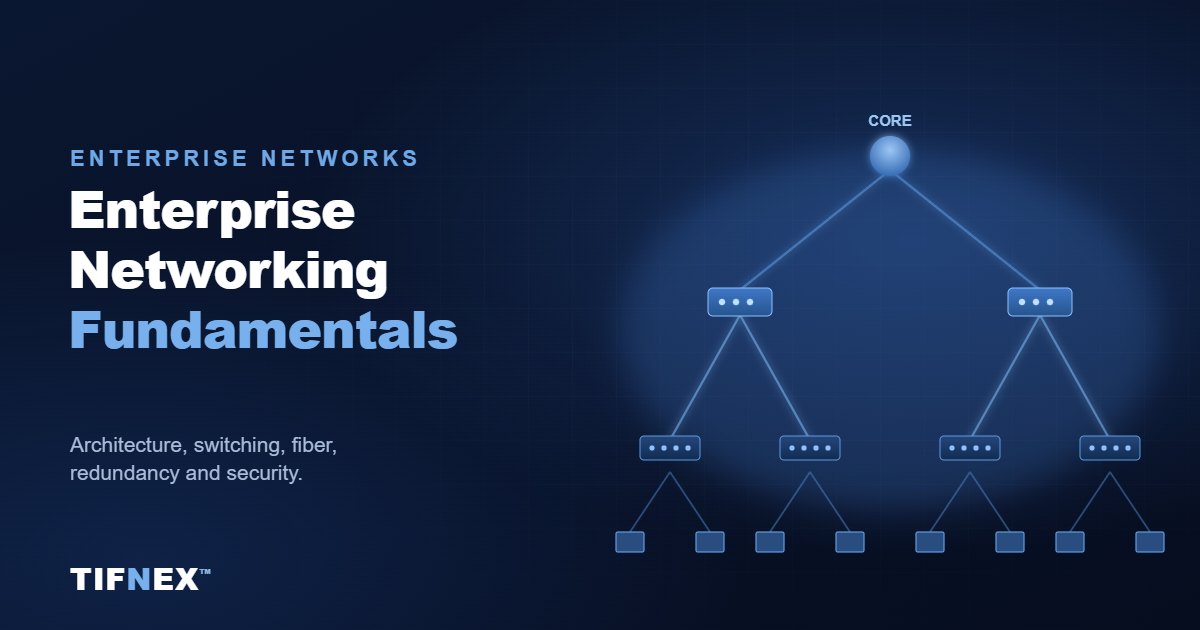
The classic three-tier model organizes the network into three layers: the access layer (where end devices connect), the distribution layer (which aggregates access switches and applies policy), and the core layer (a high-speed backbone that routes between distribution blocks). This design is well understood, easy to troubleshoot, and remains a sound choice for large campus networks with many wiring closets.
Collapsed Core (Two-Tier)
In a collapsed-core design, the distribution and core functions are merged into a single layer. This reduces cost, hardware, and complexity, making it a strong fit for small and mid-sized organizations or single-building campuses where a full three-tier hierarchy would be over-engineered.
Spine-Leaf Architecture
Modern data centers and high-performance environments increasingly adopt spine-leaf (also called leaf-spine). Every leaf switch connects to every spine switch, so any two endpoints are always the same number of hops apart. This predictable, low-latency path is ideal for the heavy “east-west” (server-to-server) traffic generated by virtualization, storage, and AI clusters. Spine-leaf scales horizontally, since you add capacity by adding spines, and pairs naturally with the demands covered in our guide to AI data center networking.
| Architecture | Best For | Key Strength | Trade-off |
|---|---|---|---|
| Three-tier | Large campus networks | Proven, easy to segment and troubleshoot | More hardware and hops |
| Collapsed core | SMBs, single buildings | Lower cost and complexity | Less headroom for growth |
| Spine-leaf | Data centers, AI/HPC | Predictable low latency, easy scaling | Higher initial port count |
Switching and Routing Fundamentals
Two functions move data across any network. Switching forwards traffic within the same segment using MAC addresses at Layer 2. Routing moves traffic between different networks or subnets using IP addresses at Layer 3. Most enterprise access switches today are multilayer (Layer 3) devices that blur the line between the two roles.
When selecting switches, weigh:
- Port speed and density: 1G to the desktop is still common, while 10G, 25G, and 100G+ uplinks connect switches and servers.
- Uplink capacity: aggregation and core switches need high-speed fiber uplinks to avoid bottlenecks.
- Power over Ethernet (PoE): for phones, wireless access points, and cameras.
- Non-blocking throughput: the switch fabric should handle all ports at full rate.
TIFNEX supplies the switches, transceivers and accessories that populate these tiers, including the pluggable optics detailed in our QSFP transceivers guide.
Structured Cabling and Fiber
The physical layer is the foundation everything else sits on. Poor cabling causes intermittent faults that are hard to diagnose, so structured cabling, a standardized, documented and labeled system, is essential.
Copper vs. Fiber
Copper (Cat6/Cat6A) is cost-effective and ideal for horizontal runs from switches to desks, supporting up to 10G over distances up to 100 meters. Fiber carries far higher bandwidth over much longer distances with immunity to electromagnetic interference, making it the standard for backbones, inter-building links, and data-center spines.
Single-Mode vs. Multimode Fiber
Multimode fiber (OM3/OM4/OM5) is optimized for short reaches, typically within a building or data center, and pairs with lower-cost optics. Single-mode fiber (OS2) carries signals over much longer distances, from campus links to metro and beyond, and is the preferred choice for future-proofing and the highest speeds.
DAC and AOC for Short Links
Inside a rack or between adjacent racks, you don’t always need fiber transceivers. Direct Attach Copper (DAC) cables provide a low-cost, low-power, low-latency connection for very short runs, typically up to a few meters. Active Optical Cables (AOC) extend that reach to tens of meters using integrated optics while remaining lighter and easier to route than discrete fiber and transceivers. Both are staples of efficient top-of-rack and spine-leaf wiring.
| Medium | Typical Reach | Best Use | Cost/Power |
|---|---|---|---|
| Copper (Cat6A) | Up to 100 m | Desk and edge connections | Low |
| DAC cable | A few meters | In-rack switch-to-server | Lowest |
| AOC cable | Tens of meters | Rack-to-rack short links | Low-moderate |
| Multimode fiber | Within a building/DC | Short high-speed links | Moderate |
| Single-mode fiber | Campus, metro, long-haul | Backbones, long runs | Higher optics cost |
Redundancy and High Availability
Downtime is expensive, so resilient networks eliminate single points of failure. Key techniques include:
- Link aggregation (LACP): bundling multiple physical links into one logical connection for both added bandwidth and automatic failover if a link drops.
- Redundant paths and switches: dual uplinks and paired core/distribution devices so any single failure is survivable.
- First-hop redundancy: protocols that provide a backup default gateway so hosts keep routing if a router fails.
- Redundant power and hardware: dual power supplies and UPS protection for critical switches.
A useful design rule: no single cable, port, switch, or power supply should be able to take down a business-critical service on its own.
Segmentation, VLANs, and Security Fundamentals
A flat network where everything can reach everything is both a performance and a security liability. VLANs (Virtual LANs) divide one physical network into isolated logical segments, separating for example guest Wi-Fi, voice, servers and user devices.
Segmentation delivers two benefits at once: it contains broadcast traffic for better performance, and it limits lateral movement so a compromised device cannot freely reach the rest of the network. Layer these security fundamentals on top:
- Access control lists and firewalling between segments to enforce least-privilege traffic.
- Network access control (NAC) and 802.1X to authenticate devices before they connect.
- A zero-trust posture: verify every user and device rather than trusting anything by default.
- Monitoring and logging for visibility into anomalies and faults.
Wireless Considerations
Wireless is now the primary access method for most users, so it deserves the same rigor as the wired network. A professional deployment starts with a site survey to plan access-point placement, channel usage, and capacity. Wi-Fi 6/6E and emerging Wi-Fi 7 improve throughput in dense environments, but wireless is only as good as the wired backbone behind it. Every access point needs adequate PoE and uplink capacity to the switch.
Scaling Toward Cloud and AI Workloads
Enterprise networks no longer end at the building. Traffic increasingly flows to public cloud, SaaS, and hybrid environments, which raises the importance of resilient internet links, SD-WAN for intelligent path selection, and secure connectivity to cloud providers.
AI and high-performance computing add another dimension: these workloads generate enormous east-west traffic and demand ultra-low-latency, high-bandwidth fabrics, which is exactly where spine-leaf designs and high-speed optics prove their value. Planning capacity headroom now avoids a disruptive redesign later, a theme explored across our cloud data centers solutions.
How to Choose an Infrastructure Partner
Technology choices matter, but execution matters more. When evaluating a networking partner, look for:
- End-to-end capability: supply of hardware plus design, installation, and ongoing support, so accountability is not fragmented across vendors.
- Vendor-neutral advice: recommendations driven by your requirements, not a single manufacturer’s catalog.
- Structured cabling expertise: because the physical layer determines long-term reliability.
- Regional presence and logistics: local stock and on-the-ground support across the UAE, Egypt, and GCC.
- Managed services: proactive monitoring and maintenance to keep the network healthy after go-live.
TIFNEX combines all of these: product supply, network design and installation, structured cabling, and managed IT services delivered from Dubai and Cairo. Explore the full range on our solutions hub.
Frequently Asked Questions
What is enterprise networking in simple terms?
Enterprise networking is the design and management of the connectivity infrastructure, meaning switches, routers, cabling and wireless, that links an organization’s devices, servers, and applications. It focuses on performance, availability, security, and scalability at a scale far beyond a home or small-office network.
What is the difference between three-tier and spine-leaf architecture?
Three-tier splits the network into access, distribution, and core layers and suits large campus environments. Spine-leaf connects every leaf switch to every spine switch so any two endpoints are equally close, providing predictable low latency ideal for data centers and AI workloads with heavy server-to-server traffic.
When should I use fiber instead of copper cabling?
Use copper (Cat6A) for shorter horizontal runs to desks and edge devices up to 100 meters. Choose fiber for backbones, links between buildings or floors, distances beyond copper’s limit, and any high-bandwidth path where you want future-proofing and immunity to electromagnetic interference.
What is the difference between DAC and AOC cables?
Direct Attach Copper (DAC) cables connect devices over very short distances of a few meters at the lowest cost and power, ideal for in-rack links. Active Optical Cables (AOC) use integrated optics to reach tens of meters while staying light and easy to route, making them well suited to rack-to-rack connections.
How do VLANs improve network security?
VLANs divide one physical network into isolated logical segments, so devices in one segment cannot freely reach another without passing through a controlled point. This contains broadcast traffic for better performance and limits an attacker’s lateral movement if a single device is compromised.
Why is redundancy important in an enterprise network?
Redundancy eliminates single points of failure so the network keeps running when a cable, port, switch, or power supply fails. Techniques such as link aggregation, redundant paths, first-hop redundancy, and dual power supplies keep business-critical services available and minimize costly downtime.
Build a Network That Scales With Your Business
Reliable enterprise networking comes from sound architecture, quality components, disciplined cabling, and expert execution working together. TIFNEX supplies the optical transceivers, DAC/AOC cables, fiber patch cords, switches, and accessories that power these networks, and backs them with design, installation, structured cabling, and managed IT services across the UAE, Egypt, and the GCC. Contact our team to plan, upgrade, or scale your business network with confidence.
One thought on “Enterprise Networking Fundamentals: Designing Reliable, High-Performance Business Networks”
Comments are closed.