
AI Data Center Networking: How GPU Clusters Are Rewiring the Network

For two decades, data-center networks assumed most traffic flows north-south, between servers and the outside world. Generative AI has broken that assumption. When thousands of GPUs train a single model, they behave less like independent servers and more like one enormous parallel computer that must exchange gradients in lockstep. The result is a fundamental rewiring of how we build networks. AI data center networking is now the discipline of moving staggering volumes of synchronized, east-west traffic between accelerators with near-zero loss and predictable latency. This guide explains why GPU clusters demand a new architecture, and what it means for the fabrics, switches, and optics that hold them together.
Why AI and GPU Training Break Traditional Network Design
Conventional enterprise and cloud networks are optimized for many small, independent flows. AI training is the opposite. A distributed training job splits a model across hundreds or thousands of GPUs, and after every computation step those GPUs must synchronize using collective operations such as all-reduce and all-to-all. Every GPU talks to every other GPU, and the whole job can only proceed at the speed of the slowest link.
This produces three defining characteristics:
- Massive east-west traffic. The dominant flows are GPU-to-GPU (server-to-server) rather than server-to-user. A single training step can push terabytes across the fabric.
- Bursty, synchronized patterns. Thousands of GPUs transmit at once, then fall silent, then transmit again. These correlated bursts create intense, momentary congestion that classic networks handle poorly.
- Tail-latency sensitivity. Because the job waits for the last GPU to finish, a single congested path or dropped packet stalls the entire cluster. In AI, the tail is the performance.
The consequence is that a network which is “good enough” for cloud applications can quietly waste millions of dollars of GPU time. This is why organizations increasingly treat the network as a first-class part of their AI infrastructure, not an afterthought.
The Two Networks: Front-End vs Back-End Fabric
Modern AI clusters run two distinct networks, and confusing them is a common design mistake.
Front-End Network
The front-end (north-south) network is the familiar one. It connects servers to storage, management, users, and the internet, carrying data ingestion, checkpoints, orchestration, and inference requests. Standard Ethernet leaf-spine designs, like those in most cloud data centers, serve this role well.
Back-End GPU Fabric
The back-end fabric is the new, performance-critical network that interconnects GPUs for training and large-scale inference. It carries the collective-operation traffic and demands the highest bandwidth, lowest latency, and lossless behavior in the building. This is where 400G, 800G, and soon 1.6T links live, and where the choice of topology and transport protocol directly determines how efficiently expensive accelerators are utilized.
Topologies: Leaf-Spine and Rail-Optimized Design
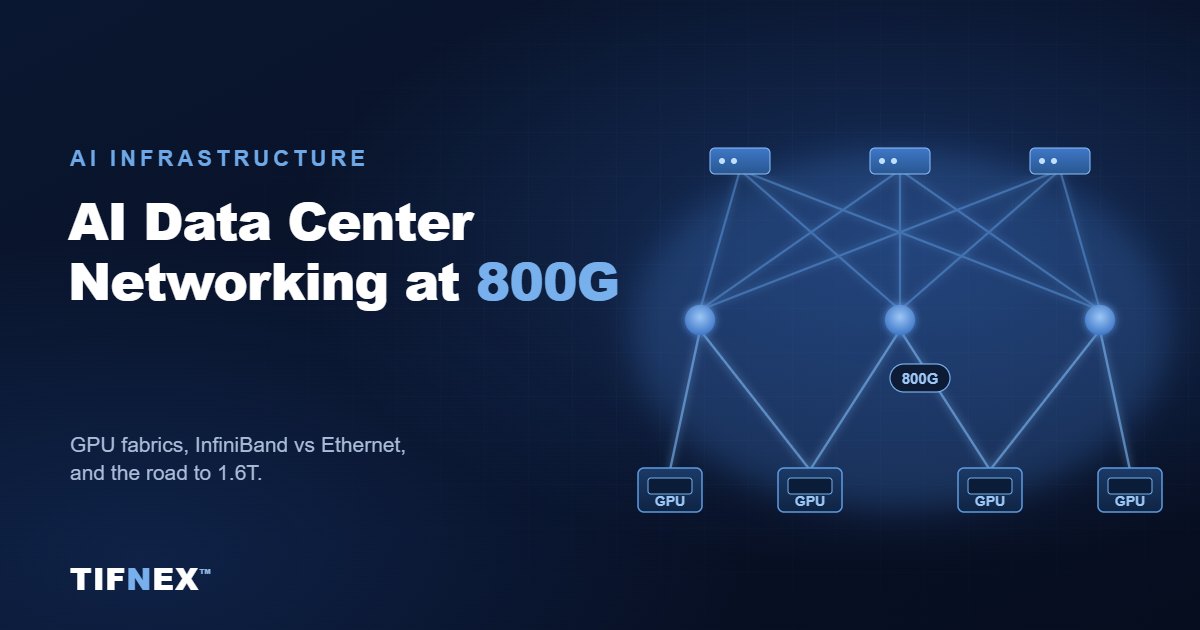
AI back-end fabrics are typically built as non-blocking, or near non-blocking, fat-tree (leaf-spine) topologies that provide full bisection bandwidth, meaning any GPU can talk to any other at full line rate. But the biggest shift in AI networking is the move to rail-optimized design.
In a rail-optimized cluster, each GPU in a server is assigned to a dedicated network plane called a “rail.” A typical eight-GPU server has eight NICs feeding eight rails; rail 0 connects GPU 0 of every server across the cluster, rail 1 connects every GPU 1, and so on. Within the server, GPUs interconnect over a high-bandwidth memory-semantic link, and each GPU reaches its counterparts elsewhere through its own rail.
The payoff is that collective-operation traffic maps cleanly onto the physical network, reducing switch hops and cross-fabric congestion. The catch is that rail-optimized fabrics demand disciplined cabling: a single mis-wired transceiver breaks rail locality and forces traffic onto slower paths. Verified optics and structured cabling matter more here than in any traditional network.
Scale-Up vs Scale-Out: Two Kinds of Interconnect
AI clusters scale in two directions, and each uses different interconnect technology.
- Scale-up tightly couples a small number of GPUs into one high-bandwidth domain, typically within a server or rack, using memory-semantic interconnects such as NVIDIA NVLink, which delivers up to 900 GB/s aggregate bandwidth per GPU in the Hopper generation. Scale-up prioritizes raw bandwidth and the lowest latency.
- Scale-out connects many GPU domains together, from dozens to tens of thousands of accelerators, using a switched InfiniBand or Ethernet fabric with pluggable optics and cables. Scale-out prioritizes reach, port count, and cost efficiency.
A well-architected AI data center blends both: fast scale-up domains stitched together by an efficient scale-out fabric.
InfiniBand vs Ethernet for AI Networking
The central architectural debate in AI networking is which transport carries the back-end fabric. Both are viable in 2025-2026, and the choice hinges on scale, ecosystem, and cost.
InfiniBand has long dominated high-performance computing because it was purpose-built for low-latency, lossless RDMA (Remote Direct Memory Access) traffic. Its current NDR generation runs at 400 Gbps per port, and the newer XDR generation reaches 800 Gbps. It offers mature congestion management and in-network computing features, but it is a specialized ecosystem with a narrower vendor base.
Ethernet, enhanced with RoCE (RDMA over Converged Ethernet), has closed the performance gap while bringing an open, multi-vendor ecosystem and familiar operations. Dell’Oro Group notes InfiniBand held over 80% of AI back-end fabric share in late 2023, but Ethernet is rapidly overtaking it as hyperscalers and GPU-cloud providers standardize on it.
| Factor | InfiniBand (NDR/XDR) | Ethernet + RoCE / Ultra Ethernet |
|---|---|---|
| Per-port speeds | 400G (NDR), 800G (XDR) | 400G, 800G today; 1.6T emerging |
| Latency | Very low, purpose-built | Very low with RoCE; improving with UEC |
| Loss behavior | Lossless by design | Lossless via PFC/ECN and UEC congestion control |
| Ecosystem | Specialized, fewer vendors | Open, broad multi-vendor |
| Operations | Requires HPC-specific skills | Familiar Ethernet tooling |
| Best fit | Tightly-tuned, single-vendor supercomputers | Scalable, cost-sensitive, multi-vendor AI clouds |
The Ultra Ethernet Consortium and Lossless Networking
The most important recent development is the Ultra Ethernet Consortium (UEC), which released Specification 1.0 in June 2025. UEC re-engineers Ethernet for AI and HPC from the transport layer up, adding modern RDMA, advanced congestion control, and multipath “packet spraying” that spreads a single flow across many links to avoid hot spots. It is designed to make standard Ethernet behave like a lossless, low-latency AI fabric while preserving open, multi-vendor interoperability across NICs, switches, optics, and cables. Together, Ultra Ethernet and RoCE make Ethernet the pragmatic default for scale-out.
The Optics Shift: 800G Today, 1.6T Tomorrow
Bandwidth demand at the accelerator has dragged the entire optical supply chain forward. In 2025 the majority of new AI switch ports are deployed at 800 Gbps; Dell’Oro projects 1.6 Tbps ports arriving around 2027 and 3.2 Tbps later in the decade. This cadence directly shapes procurement of transceivers, cables, and switches.
| Generation | Typical form factor | Status in AI fabrics (2025-2026) |
|---|---|---|
| 400G | QSFP-DD / OSFP | Widely deployed; now the baseline |
| 800G | OSFP / QSFP-DD800 | Mainstream for new GPU clusters |
| 1.6T | OSFP / OSFP-XD | Emerging; ramping toward 2027 |
Cabling and Optics Implications
Different links in the fabric call for different media, and getting this mix right controls both cost and power:
- DAC (Direct Attach Copper) cables are the cheapest, lowest-power option for very short reaches, typically inside a rack, such as GPU-to-top-of-rack connections.
- AOC (Active Optical Cables) extend reach to tens of meters with lower weight than copper, useful for rack-to-rack rail connections.
- Single-mode transceivers with fiber patch cords handle the longer spine and cross-hall links where distance rules out copper.
Two forward-looking trends target the power problem, since optics consume a large share of switch energy at 800G and above. Linear-drive pluggable optics (LPO) remove power-hungry digital signal processing from the module, cutting power and latency for short reaches while keeping a pluggable form factor. Co-packaged optics (CPO) go further, integrating optical engines beside the switch ASIC to slash energy per bit, and are expected to gain traction in the 1.6T era.
Because the fabric is only as reliable as its weakest connector, sourcing verified, interoperable optics and cables is critical. For a deeper look at module types, see our QSFP transceivers guide, and browse available modules and cabling in the TIFNEX product catalog.
Bringing It Together for Regional Deployments
For architects across the UAE, Egypt, and the wider GCC, the takeaway is that AI clusters need a purpose-built back-end fabric alongside a robust front-end network. The winning approach combines rail-optimized leaf-spine design, Ethernet-plus-RoCE or Ultra Ethernet transport for scale-out, high-bandwidth scale-up domains, and a well-chosen mix of DAC, AOC, and single-mode optics. These principles complement sound enterprise network fundamentals, covered in our enterprise networking guide. Explore the full range on the TIFNEX solutions hub.
Frequently Asked Questions
What is AI data center networking?
AI data center networking is the design and operation of the high-bandwidth, low-latency network that interconnects GPUs in a training or large-scale inference cluster. Unlike traditional networks built for north-south traffic, it is optimized for massive, synchronized east-west traffic between accelerators, with lossless behavior and predictable tail latency.
What is the difference between the front-end and back-end network in an AI cluster?
The front-end (north-south) network connects servers to storage, users, and the internet, like a standard data-center network. The back-end fabric is a separate, high-performance network that interconnects GPUs for collective operations during training, running at 400G or 800G with the strictest latency and loss requirements.
Is InfiniBand or Ethernet better for AI networking?
Both work. InfiniBand offers mature, purpose-built low-latency performance and suits tightly-tuned single-vendor supercomputers. Ethernet with RoCE and the new Ultra Ethernet standard offers an open, multi-vendor, cost-effective fabric and is rapidly becoming the default for scalable AI clouds, having largely closed the performance gap.
What is rail-optimized network topology?
Rail-optimized topology assigns each GPU in a server to a dedicated network plane, or “rail,” so that matching GPUs across all servers connect through the same set of switches. This aligns the physical network with the traffic patterns of AI collective operations, reducing hops and congestion, but it requires precise, correct cabling to preserve rail locality.
Why is the industry moving to 800G and 1.6T optics?
GPU bandwidth demand doubles rapidly, so switch ports must keep pace. Most new AI clusters in 2025 deploy 800G ports, with 1.6T expected to ramp toward 2027. Higher-speed optics reduce the links and switches needed per unit of bandwidth, improving cost per bit.
What cabling and optics do AI clusters use?
AI clusters mix media by reach: DAC (direct attach copper) for the shortest, lowest-power in-rack links; AOC (active optical cables) for rack-to-rack connections up to tens of meters; and single-mode transceivers with fiber patch cords for longer spine and cross-hall links. Emerging linear-drive (LPO) and co-packaged (CPO) optics target lower power at 800G and beyond.
Build Your AI Fabric with Confidence
Rewiring the network for GPU clusters is where much of your AI performance and cost efficiency is won or lost. Whether you are planning a new back-end fabric, upgrading to 800G, or sourcing verified transceivers and cables across the UAE, Egypt, and the GCC, TIFNEX can help you specify the right components and topology. Contact our team to discuss your AI networking requirements.
2 thoughts on “AI Data Center Networking: How GPU Clusters Are Rewiring the Network”
Comments are closed.